GTS News Center & Latest Updates
Your Most Professional Enterprise Systems and Software Custom Development Provider!



GTS News Center & Latest Updates
How to establish a stable, secure, and sustainably scalable trading system architecture in a multi-platform environment? This is a key issue that institutions face today, where the digitalization of financial transactions has become the norm. For securities firms, asset management companies, and fintech platforms, the web, mobile app, and back-end operating system are not independent entities, but rather a highly collaborative whole. This article will focus on this, discussing the core logic and common challenges of developing a multi-platform financial trading system, and how to avoid redundant investment and build a truly operational financial service IT solution through reasonable system design!

Financial customer behavior is no longer concentrated on a single terminal. In the Hong Kong market, different use cases present distinct needs for trading platforms:
Web Platforms: Primarily geared towards professional investors, internal operators, and management, emphasizing information integrity, data visualization, and batch processing capabilities;
Mobile Apps: Targeting high-frequency users and real-time trading needs, prioritizing speed, stability, and intuitive operation;
Back-end Systems: Supporting overall operations, including account management, risk control, compliance monitoring, reporting, and system settings.
If a company designs a system specifically for a single platform, it often encounters significant bottlenecks after business expansion, such as incompatible functionality, inconsistent data, or even the need to redevelop the entire system. Therefore, the core of developing a multi-platform financial trading system lies not in creating a few interfaces, but in having a shared system core.
Many enterprises, when initially planning multi-platform trading systems, often overlook the complexity of integration, leading to a rapid increase in subsequent operational costs. The following three are among the most common problems:
If the Web, App, and backend are developed by different teams or vendors, the common result is: the same trading rules are implemented repeatedly + risk control logic differs across platforms, requiring simultaneous adjustments to multiple systems to modify a single rule. This structure may be manageable when the system is small, but as trading volume and product lines increase, technical debt accumulates rapidly.
Financial transactions heavily rely on real-time data. When platforms lack a unified data source and status management mechanism, it often leads to inconsistencies in asset information seen by users on the App and Web, a lack of real-time synchronization between backend risk control judgments and frontend trading status, and even discrepancies between operational reports and actual trading results. These problems weaken user trust and may further amplify compliance and operational risks.
In the system design of Hong Kong financial institutions, hierarchical control of operational permissions, complete audit records of transactions and data access, and traceability of system behavior are fundamental requirements that cannot be ignored. If multiple platforms do not share a unified access and log management mechanism, the additional costs incurred later to meet compliance and internal control requirements usually far exceed the initial costs planned for the system.

The key to developing a truly mature multi-platform financial trading system is to first design the architecture, then the interfaces.
Instead of implementing trading logic separately for the Web, App, and backend, it is better to centralize core capabilities such as trading, account management, and risk control in the backend service layer and provide them to different platforms through standardized APIs.
The interface requirements for the Web and App differ, but the underlying trading logic should be consistent. By decoupling the front-end and back-end, enterprises can flexibly adjust interfaces and functionalities according to business needs without affecting the core system, and launch new modules in stages, reducing deployment risks.
Developing a multi-platform financial trading system is not merely about enabling trading; it's an integral part of enterprise operations. Therefore, considering permission and role models, operation logs and auditing requirements, as well as system monitoring and anomaly handling processes during the system architecture design phase effectively avoids the high costs of later remediation and reconstruction.
Unlike developing separate systems for each platform, GTS's financial services IT solutions emphasize integrating business processes and terminal application logic first, then establishing a unified system core. This allows the Web, App, and back-end to share the same basic capabilities, reducing subsequent maintenance and reconstruction risks from the outset.
Many enterprises, when evaluating trading systems, tend to overemphasize technical specifications or feature lists, neglecting whether the system can adapt to business growth. A truly viable multi-platform architecture should support gradual expansion, clear module division of labor, and maintain the flexibility to integrate with existing systems, ensuring that the system's long-term development is not limited by short-term needs.
This is why more and more financial institutions, when planning their trading platforms, are prioritizing technology partners like GTS, which possess overall system integration capabilities and long-term operational experience, rather than simply purchasing off-the-shelf products with full functionality but limited scalability.
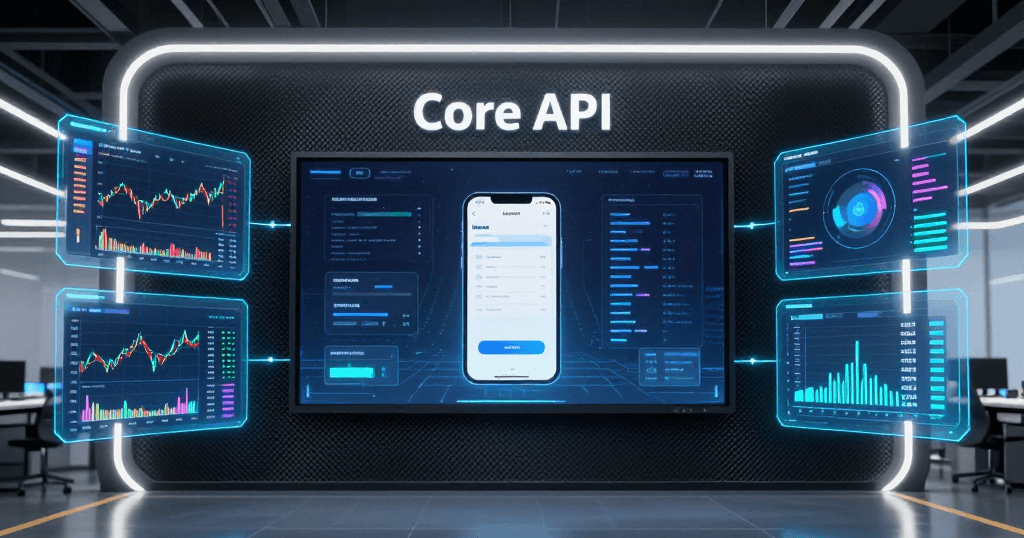
The essence of developing a multi-platform financial trading system lies not in "how many functions to add," but in establishing a system foundation that can operate sustainably in the long term. When the web, app, and backend can collaborate stably within the same architecture, enterprises can truly balance user experience, operational efficiency, and compliance requirements. Through clear architectural planning and phased implementation, even without extensive case studies, enterprises can still robustly build financial service IT solutions that meet their specific needs, reserving sufficient space for future business expansion.
This article, "Multi-Platform Financial Trading System Development: How to Integrate Web, App, and Back-End?" was compiled and published by GTS Enterprise Systems and Software Development Service Provider. For reprint permission, please indicate the source and link: https://www.globaltechlimited.com/news/post-id-10/